 Add to Chrome
 Add to Firefox
 Add to Edge
GLIDE: Graph-guided Leap Inference for Diffusion Estimation of Spatio-Temporal Point Processes
May 31, 2026
Spatio-temporal point processes (STPPs) provide a principled framework for modeling asynchronous events in continuous time and space. Recent diffusion-based approaches offer a flexible alternative to deterministic prediction by modeling complex conditional distributions, but their application to STPPs remains challenging: reverse sampling from pure noise is costly, and weak structural constraints in sparse spatial domains can lead to poorly localized probability mass. We propose \textbf{GLIDE} (Graph-guided Leap Inference for Diffusion Estimation), a conditional diffusion framework for next-event modeling in STPPs. GLIDE organizes historical events into a multi-scale historical graph and encodes temporal evolution and spatial topology through a dual-stream architecture, yielding a structured conditioning context for a dual-branch diffusion denoiser. It further introduces a prior-guided leap inference mechanism, in which a lightweight mean predictor provides a deterministic anchor and the reverse process starts from an intermediate diffusion step instead of from pure Gaussian noise. Experiments on multiple real-world datasets show that GLIDE improves both distribution fitting and next-event prediction, with the largest gains appearing on the spatial side. The results also indicate that prior-guided leap inference substantially reduces reverse-sampling cost while preserving the stochastic generation capability of diffusion models.

FAiT: Frequency-Aware Inverted Transformer for Multivariate Time Series Forecasting
May 31, 2026While Transformer-based architectures have established themselves as a dominant paradigm in Multivariate Time Series Forecasting (MTSF), their core self-attention mechanism inherently functions as a low-pass filter, systematically smoothing out high-frequency signals vital for sharp local changes. Recent advancements have increasingly incorporated frequency-domain operations to address this bias, however, most existing designs rely on fixed spectral bases and apply sequence-wise (uniform) modulation, implicitly assuming a time-invariant frequency response. This overlooks a key property of real-world series that their spectral characteristics often evolve over time, making uniform modulation insufficient for capturing fine-grained temporal dynamics. To tackle these limitations, we propose FAiT, a Frequency-Aware inverted Transformer. Specifically, FAiT rectifies the spectral bias internally through Inverted Attention, which interprets the attention map as a learnable low-pass operator and constructs a dedicated complementary high-pass branch by inverting the attention matrix to recover attenuated transient signals. Furthermore, FAiT introduces Dynamic Temporal-Frequency Modulation (DTFM), which synthesizes instance-conditioned weights to adaptively re-calibrate the energy of spectral sub-bands, enabling fine-grained control over evolving multi-scale patterns. Extensive experiments on widely used benchmarks demonstrate that FAiT consistently outperforms state-of-the-art Transformer-based and frequency-enhanced baselines, while maintaining computational efficiency.
SciEval: A Benchmark for Automatic Evaluation of K-12 Science Instructional Materials
Apr 28, 2026The need to evaluate instructional materials for K-12 science education has become increasingly important, as more educators use generative AI to create instructional materials. However, the review of instructional materials is time-consuming, expertise-intensive, and difficult to scale, motivating interest in automated evaluation approaches. While large language models (LLMs) have shown strong performance on general evaluation tasks, their performance and reliability on instructional materials remain unclear. To address this gap, we formulate Automatic Instructional Materials Evaluation (AIME) as a generative AI task that predicts scores and evidence using the rubric designed by the educator. We create a benchmark dataset and develop baseline models for AIME. First, we curate the first AIME dataset, SciEval, consisting of instructional materials annotated with pedagogy-aligned evaluation scores and evidence-based rationales. Expert annotations achieve high inter-rater reliability, resulting in a dataset of 273 lesson-level instructional materials evaluated across 13 criteria (N=3549) using the EQuIP rubric. Second, we test mainstream LLMs (GPT, Gemini, Llama, and Qwen) on SciEval and find that none achieve strong performance. Then we fine-tune Qwen3 on SciEval. Results on a held-out test set show that domain-aligned fine-tuning can achieve up to 11 percent performance gains, highlighting the importance of domain-specific fine-tuning for AIME and facilitating the use of LLMs in other educational tasks.
HY-World 2.0: A Multi-Modal World Model for Reconstructing, Generating, and Simulating 3D Worlds
Apr 15, 2026We introduce HY-World 2.0, a multi-modal world model framework that advances our prior project HY-World 1.0. HY-World 2.0 accommodates diverse input modalities, including text prompts, single-view images, multi-view images, and videos, and produces 3D world representations. With text or single-view image inputs, the model performs world generation, synthesizing high-fidelity, navigable 3D Gaussian Splatting (3DGS) scenes. This is achieved through a four-stage method: a) Panorama Generation with HY-Pano 2.0, b) Trajectory Planning with WorldNav, c) World Expansion with WorldStereo 2.0, and d) World Composition with WorldMirror 2.0. Specifically, we introduce key innovations to enhance panorama fidelity, enable 3D scene understanding and planning, and upgrade WorldStereo, our keyframe-based view generation model with consistent memory. We also upgrade WorldMirror, a feed-forward model for universal 3D prediction, by refining model architecture and learning strategy, enabling world reconstruction from multi-view images or videos. Also, we introduce WorldLens, a high-performance 3DGS rendering platform featuring a flexible engine-agnostic architecture, automatic IBL lighting, efficient collision detection, and training-rendering co-design, enabling interactive exploration of 3D worlds with character support. Extensive experiments demonstrate that HY-World 2.0 achieves state-of-the-art performance on several benchmarks among open-source approaches, delivering results comparable to the closed-source model Marble. We release all model weights, code, and technical details to facilitate reproducibility and support further research on 3D world models.
Bridging Discrete Marks and Continuous Dynamics: Dual-Path Cross-Interaction for Marked Temporal Point Processes
Mar 12, 2026Predicting irregularly spaced event sequences with discrete marks poses significant challenges due to the complex, asynchronous dependencies embedded within continuous-time data streams.Existing sequential approaches capture dependencies among event tokens but ignore the continuous evolution between events, while Neural Ordinary Differential Equation (Neural ODE) methods model smooth dynamics yet fail to account for how event types influence future timing.To overcome these limitations, we propose NEXTPP, a dual-channel framework that unifies discrete and continuous representations via Event-granular Neural Evolution with Cross-Interaction for Marked Temporal Point Processes. Specifically, NEXTPP encodes discrete event marks via a self-attention mechanism, simultaneously evolving a latent continuous-time state using a Neural ODE. These parallel streams are then fused through a crossattention module to enable explicit bidirectional interaction between continuous and discrete representations. The fused representations drive the conditional intensity function of the neural Hawkes process, while an iterative thinning sampler is employed to generate future events. Extensive evaluations on five real-world datasets demonstrate that NEXTPP consistently outperforms state-of-the-art models. The source code can be found at https://github.com/AONE-NLP/NEXTPP.
How Uncertain Is the Grade? A Benchmark of Uncertainty Metrics for LLM-Based Automatic Assessment
Feb 17, 2026The rapid rise of large language models (LLMs) is reshaping the landscape of automatic assessment in education. While these systems demonstrate substantial advantages in adaptability to diverse question types and flexibility in output formats, they also introduce new challenges related to output uncertainty, stemming from the inherently probabilistic nature of LLMs. Output uncertainty is an inescapable challenge in automatic assessment, as assessment results often play a critical role in informing subsequent pedagogical actions, such as providing feedback to students or guiding instructional decisions. Unreliable or poorly calibrated uncertainty estimates can lead to unstable downstream interventions, potentially disrupting students' learning processes and resulting in unintended negative consequences. To systematically understand this challenge and inform future research, we benchmark a broad range of uncertainty quantification methods in the context of LLM-based automatic assessment. Although the effectiveness of these methods has been demonstrated in many tasks across other domains, their applicability and reliability in educational settings, particularly for automatic grading, remain underexplored. Through comprehensive analyses of uncertainty behaviors across multiple assessment datasets, LLM families, and generation control settings, we characterize the uncertainty patterns exhibited by LLMs in grading scenarios. Based on these findings, we evaluate the strengths and limitations of different uncertainty metrics and analyze the influence of key factors, including model families, assessment tasks, and decoding strategies, on uncertainty estimates. Our study provides actionable insights into the characteristics of uncertainty in LLM-based automatic assessment and lays the groundwork for developing more reliable and effective uncertainty-aware grading systems in the future.
Negative-Aware Diffusion Process for Temporal Knowledge Graph Extrapolation
Feb 09, 2026Temporal Knowledge Graph (TKG) reasoning seeks to predict future missing facts from historical evidence. While diffusion models (DM) have recently gained attention for their ability to capture complex predictive distributions, two gaps remain: (i) the generative path is conditioned only on positive evidence, overlooking informative negative context, and (ii) training objectives are dominated by cross-entropy ranking, which improves candidate ordering but provides little supervision over the calibration of the denoised embedding. To bridge this gap, we introduce Negative-Aware Diffusion model for TKG Extrapolation (NADEx). Specifically, NADEx encodes subject-centric histories of entities, relations and temporal intervals into sequential embeddings. NADEx perturbs the query object in the forward process and reconstructs it in reverse with a Transformer denoiser conditioned on the temporal-relational context. We further derive a cosine-alignment regularizer derived from batch-wise negative prototypes, which tightens the decision boundary against implausible candidates. Comprehensive experiments on four public TKG benchmarks demonstrate that NADEx delivers state-of-the-art performance.
DrawSim-PD: Simulating Student Science Drawings to Support NGSS-Aligned Teacher Diagnostic Reasoning
Feb 02, 2026Developing expertise in diagnostic reasoning requires practice with diverse student artifacts, yet privacy regulations prohibit sharing authentic student work for teacher professional development (PD) at scale. We present DrawSim-PD, the first generative framework that simulates NGSS-aligned, student-like science drawings exhibiting controllable pedagogical imperfections to support teacher training. Central to our approach are apability profiles--structured cognitive states encoding what students at each performance level can and cannot yet demonstrate. These profiles ensure cross-modal coherence across generated outputs: (i) a student-like drawing, (ii) a first-person reasoning narrative, and (iii) a teacher-facing diagnostic concept map. Using 100 curated NGSS topics spanning K-12, we construct a corpus of 10,000 systematically structured artifacts. Through an expert-based feasibility evaluation, K--12 science educators verified the artifacts' alignment with NGSS expectations (>84% positive on core items) and utility for interpreting student thinking, while identifying refinement opportunities for grade-band extremes. We release this open infrastructure to overcome data scarcity barriers in visual assessment research.
HY-Motion 1.0: Scaling Flow Matching Models for Text-To-Motion Generation
Dec 29, 2025We present HY-Motion 1.0, a series of state-of-the-art, large-scale, motion generation models capable of generating 3D human motions from textual descriptions. HY-Motion 1.0 represents the first successful attempt to scale up Diffusion Transformer (DiT)-based flow matching models to the billion-parameter scale within the motion generation domain, delivering instruction-following capabilities that significantly outperform current open-source benchmarks. Uniquely, we introduce a comprehensive, full-stage training paradigm -- including large-scale pretraining on over 3,000 hours of motion data, high-quality fine-tuning on 400 hours of curated data, and reinforcement learning from both human feedback and reward models -- to ensure precise alignment with the text instruction and high motion quality. This framework is supported by our meticulous data processing pipeline, which performs rigorous motion cleaning and captioning. Consequently, our model achieves the most extensive coverage, spanning over 200 motion categories across 6 major classes. We release HY-Motion 1.0 to the open-source community to foster future research and accelerate the transition of 3D human motion generation models towards commercial maturity.
Exploiting Inter-Session Information with Frequency-enhanced Dual-Path Networks for Sequential Recommendation
Nov 14, 2025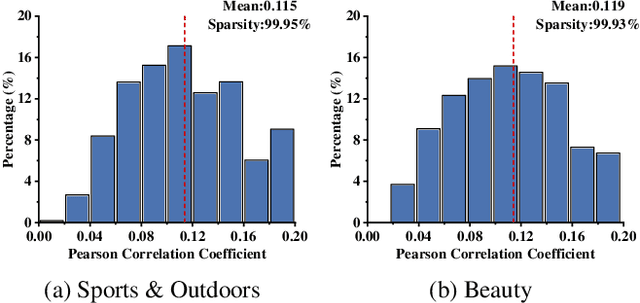
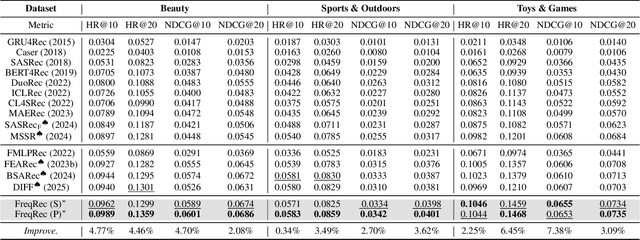
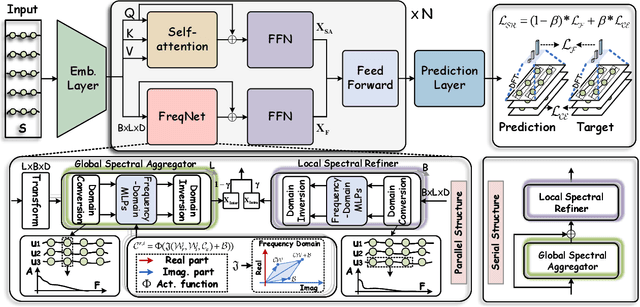

Sequential recommendation (SR) aims to predict a user's next item preference by modeling historical interaction sequences. Recent advances often integrate frequency-domain modules to compensate for self-attention's low-pass nature by restoring the high-frequency signals critical for personalized recommendations. Nevertheless, existing frequency-aware solutions process each session in isolation and optimize exclusively with time-domain objectives. Consequently, they overlook cross-session spectral dependencies and fail to enforce alignment between predicted and actual spectral signatures, leaving valuable frequency information under-exploited. To this end, we propose FreqRec, a Frequency-Enhanced Dual-Path Network for sequential Recommendation that jointly captures inter-session and intra-session behaviors via a learnable Frequency-domain Multi-layer Perceptrons. Moreover, FreqRec is optimized under a composite objective that combines cross entropy with a frequency-domain consistency loss, explicitly aligning predicted and true spectral signatures. Extensive experiments on three benchmarks show that FreqRec surpasses strong baselines and remains robust under data sparsity and noisy-log conditions.